
Disclosure: This guide is based on published manufacturer specifications and electrical-load analysis. Tool Honest Review has not hands-on tested every power station discussed here. Product specifications and configurations can change, so verify current details with the manufacturer before purchasing.
As an Amazon Associate, we earn from qualifying purchases. Some links on this site are affiliate links.
Check current prices
Prices and availability change. These buttons go to the products discussed in this guide.
| Specification | Why it matters for tools | What to verify |
|---|---|---|
| Continuous AC output | Determines the load the inverter can sustain | Compare with the tool nameplate—not battery capacity |
| Surge behavior | Motors may demand extra power while starting | Check the manual for peak limits and duration |
| Battery capacity | Influences potential runtime | Plan with usable energy after conversion losses |
| AC outlet limits | An individual outlet may have a lower limit | Verify per-outlet and combined-output ratings |
| Recharge time | Affects multi-day jobsite use | Compare AC, vehicle and solar input limits |
Portable power stations for power tools must deliver enough continuous and surge wattage for chargers, saws, compressors, and other demanding jobsite equipment without overloading the inverter.
Portable Power Station Comparison Checklist
Evidence and sources
This is specification-based analysis, not a hands-on comparison. Product rankings should be checked against the exact model’s current manufacturer page and manual. Verify the listed models against the official EcoFlow DELTA 2 Max specifications, Jackery Explorer 2000 v2 specifications, and EcoFlow DELTA 3 Plus specifications. Runtime figures are estimates unless explicitly labeled as measured.
Portable power stations have become powerful enough to run equipment that would have required a gas generator just a few years ago.
But there is an important catch: not every portable power station can run every power tool.
A cordless-tool charger is an easy load. A 15-amp circular saw, table saw, miter saw, or air compressor is a completely different problem. The station needs enough continuous inverter output to handle the tool while it is running—and enough headroom for motor startup demands.
Quick answer: For serious corded power-tool use, we generally prefer power stations in roughly the 2,000W+ output class. Smaller units can work well for charging cordless batteries and operating lighter equipment, but demanding saws and compressors require considerably more attention to output and startup requirements.
Best Portable Power Stations for Power Tools: Quick Comparison
| Power Station | Battery Capacity | Rated AC Output | Best For |
|---|---|---|---|
| EcoFlow DELTA 2 Max | 2,048Wh | 2,400W | Heavy-duty workshop use |
| Jackery Explorer 2000 v2 | 2,042Wh | 2,200W | Best balance of capacity and portability |
| EcoFlow DELTA 3 Plus | 1,024Wh | 1,800W | Lighter tools and portability |
Our overall pick: EcoFlow DELTA 2 Max
Best portable option: Jackery Explorer 2000 v2
Best for lighter-duty use: EcoFlow DELTA 3 Plus
1. EcoFlow DELTA 2 Max — Best Overall for Power Tools
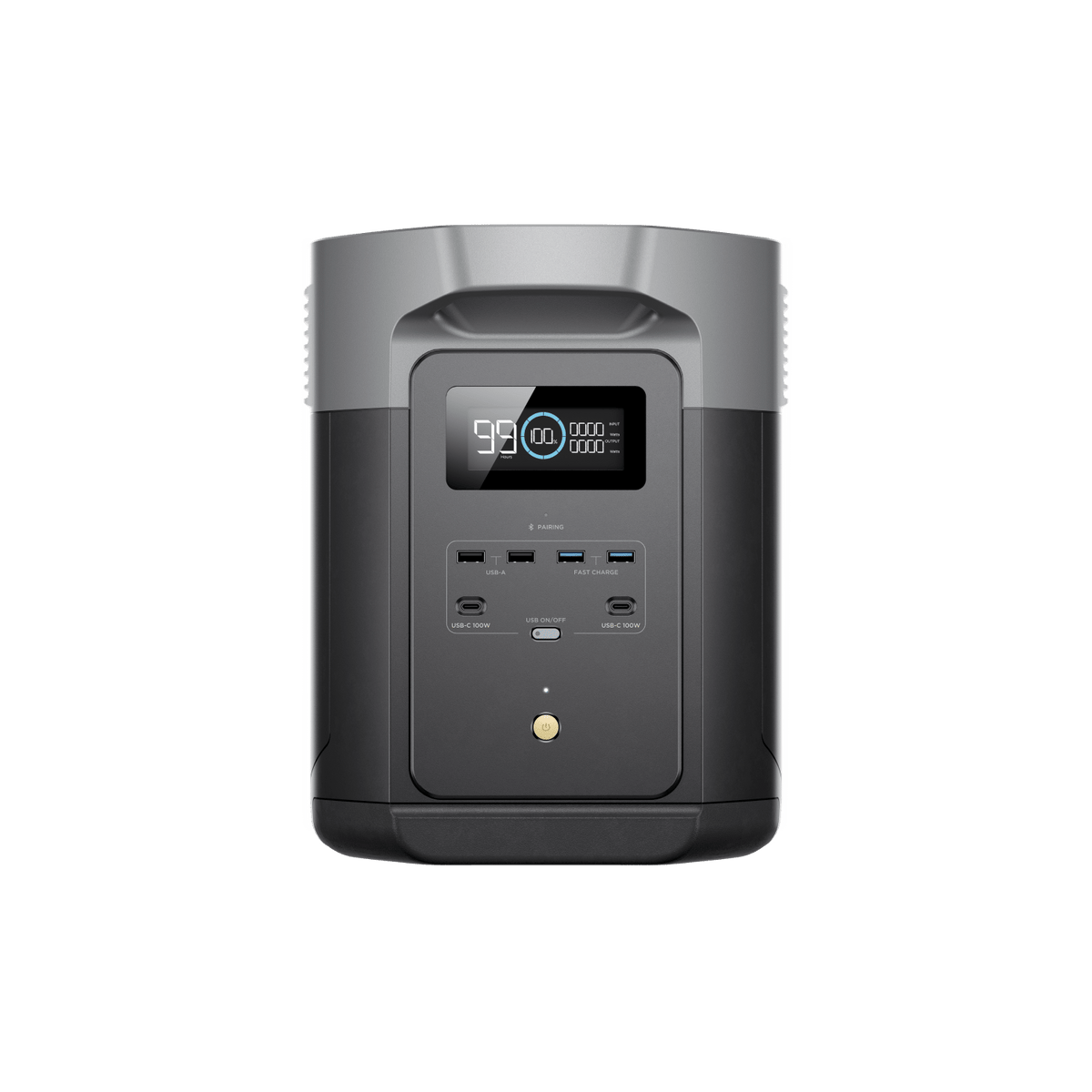
The EcoFlow DELTA 2 Max is our updated pick here after the previous pick, the BLUETTI AC200L, went persistently out of stock. It matches the AC200L on the two specs that matter most for tool use: a 2,048Wh LiFePO4 battery with 2,400W of rated AC output (X-Boost mode can push that to 3,400W for brief high-draw startups).
Key Specifications
- Battery capacity: 2,048Wh
- Rated AC output: 2,400W (X-Boost surge to 3,400W)
- Battery chemistry: LiFePO4
- AC outlets: 6
- Maximum solar input: 1,000W
- Weight: approximately 50 lb
Why We Like It for Tools
The 2,400W inverter provides more breathing room than smaller 1,500–1,800W power stations. That is useful for circular saws, miter saws, angle grinders, drills, sanders, shop vacuums, cordless battery chargers, and some air compressors.
That does not mean every 2,400W power station will operate every tool rated below 2,400W. Motor startup characteristics, actual load, and manufacturer limitations still matter.
Downsides
Maximum solar input is 1,000W, lower than the AC200L’s advertised 1,200W — a minor consideration if you plan to recharge primarily off-grid. The 3,400W X-Boost figure is a surge mode for brief high-draw startups, not a sustained output rating; for continuous heavy loads, plan around the 2,400W rated figure.
2. Jackery Explorer 2000 v2 — Best Balance
The Jackery Explorer 2000 v2 provides 2,042Wh of battery capacity and 2,200W of rated AC output while weighing around 39.5 pounds. Jackery also rates it for up to 4,400W instantaneous output, although buyers should not confuse a surge specification with the 2,200W continuous rating.
Key Specifications
- Battery capacity: 2,042Wh
- Rated AC output: 2,200W
- Peak output: 4,400W
- Battery chemistry: LiFePO4
- AC outlets: 3
- Weight: approximately 39.5 lb
Why We Like It
For users moving between a truck, garage, workshop, and jobsite, weight matters. The Explorer 2000 v2 provides a large battery and 2,200W inverter without reaching the weight of some competing high-capacity systems.
Downsides
You get three AC outlets rather than the six available on the DELTA 2 Max, and extremely demanding equipment can still exceed what a station in this class can comfortably handle.
3. EcoFlow DELTA 3 Plus — Best for Portability and Lighter Tools
If your primary goal is charging cordless-tool batteries and running lighter or intermittent loads, a smaller unit may make more sense. The EcoFlow DELTA 3 Plus provides a 1,024Wh battery and 1,800W rated AC output while weighing approximately 27.6 pounds.
Key Specifications
- Battery capacity: 1,024Wh
- Rated AC output: 1,800W
- Battery chemistry: LiFePO4
- AC outlets: 6
- Weight: approximately 27.6 lb
Why We Like It
Its smaller size makes it much easier to transport. It is particularly attractive for charging cordless batteries, drills, sanders, smaller grinders, lights, electronics, and intermittent tool use. The six AC outlets are also useful when it functions as a central charging station.
The Limitation
Some high-draw 15-amp corded tools can approach the limits of an 1,800W-class inverter before startup demands are considered. For heavy saws and compressors, we generally prefer additional inverter headroom.
Ready to buy? Check current prices
Prices and availability change, so confirm the exact model and configuration before you order.
How Many Watts Does a Power Tool Actually Need?
Watts (W)
Watts tell us how much power the inverter can deliver at a given time. This determines whether the station can operate the tool.
Watt-Hours (Wh)
Watt-hours describe stored energy. This primarily affects how long the power station can operate a load.
A 2,000Wh battery does not automatically mean it can operate a 2,000W tool. Likewise, a station with a powerful inverter but relatively small battery might run the tool successfully, but only for limited cumulative runtime. You need to consider both.
Do Not Ignore Startup Power
Power tools containing motors do not necessarily draw the same amount of power every second. Starting the motor can create a brief demand above the normal running load. This is especially important with air compressors, table saws, miter saws, circular saws, shop vacuums, and pumps.
That is why we do not recommend choosing a power station whose rated output merely matches the theoretical running wattage of your tool. Headroom matters.
What About a 15-Amp Power Tool?
Corded tools are often labeled 120V / 15A. Multiplying 120 volts by 15 amps gives 1,800 watts, which is useful as an upper-bound electrical reference but not a precise measurement of continuous consumption. Actual draw changes with load.
Check manufacturer specifications and, where appropriate, measured consumption rather than assuming every 15A tool continuously consumes exactly 1,800W.
Can a Portable Power Station Run a Circular Saw?
Potentially, yes. A high-powered corded circular saw can place a significant load on the inverter, particularly during startup and demanding cuts. For frequent corded saw use, we would start in the 2,000W+ inverter class.
Can a Portable Power Station Run a Miter Saw?
Many can, provided the inverter is appropriately sized. Motor startup is the key consideration. If your miter saw is the primary reason you are buying the station, check inverter output before battery capacity.
Can a Portable Power Station Run an Air Compressor?
This is a more difficult load. Compressors can have substantial startup demands and vary dramatically in motor size. We would want the exact compressor model and electrical specifications before recommending a station.
Can You Charge Cordless Tool Batteries From a Power Station?
Yes, and this is arguably one of the best uses for portable power stations. A station can serve as a mobile charging center for DeWalt, Milwaukee, Makita, Ryobi, Bosch, FLEX, Ridgid, and other battery platforms. A 1,000Wh-class station can potentially provide many recharges depending on battery size, charger consumption, and conversion losses.
Portable Power Station vs. Gas Generator for Power Tools
Portable Power Station Advantages
- No gasoline-engine exhaust during operation
- Low operating noise
- Minimal routine engine maintenance
- Instant electricity at the push of a button
Gas Generator Advantages
- Fast refueling for long-duration work
- Support for very high loads
- Potentially lower upfront cost per unit of sustained power
For intermittent tool use, cordless charging, garages, and noise-sensitive environments, we prefer the convenience of a portable power station. For an all-day remote jobsite running large equipment continuously, a gas generator may still be more practical.
How We Evaluate Power Stations for Tool Use
Tool Honest Review does not evaluate a power station solely by battery capacity. For tool applications, we consider continuous AC output, startup capability, battery capacity, portability, outlet configuration, recharge options, battery chemistry, and expected longevity.
Testing transparency: The recommendations in this guide come from published specifications and electrical requirements, not a claim that we personally ran every listed tool from every station. Real-world results can vary with the exact tool, load, temperature, battery state, and firmware or product revision.
Our Recommendation
For serious corded power-tool use, the EcoFlow DELTA 2 Max is our overall pick of these three because its 2,400W rated output matches the strongest continuous inverter specification in this comparison.
The Jackery Explorer 2000 v2 is particularly compelling if portability matters. For lighter equipment and cordless-tool charging, we would choose the EcoFlow DELTA 3 Plus.
Choose the inverter for your tool first. Then choose enough battery capacity for the runtime you need.
Frequently Asked Questions
What size power station do I need for power tools?
It depends on the equipment. Smaller stations can handle chargers and lighter tools, while demanding corded saws and compressors may require 2,000W or more of inverter capability.
Is 1,000W enough for power tools?
For some tools, yes. For others, no. Check the individual tool rather than treating power tools as one electrical category.
Is 2,000W enough for a circular saw?
It may be, but the saw specifications, actual load, and startup requirements matter. Additional inverter headroom is preferable.
Are portable power stations safe to use indoors?
Battery stations do not produce gasoline-engine exhaust during normal operation, but users should still follow manufacturer safety, ventilation, charging, temperature, and placement instructions.
Is a power station better than a generator?
For quiet, intermittent power and cordless battery charging, it often can be. For continuous high-power operation, a conventional generator may still be more practical.
Final Thoughts
Portable power stations are finally reaching the point where they are genuinely useful pieces of workshop and jobsite equipment rather than oversized phone chargers. But buying based on battery capacity alone is a mistake.
Start with the tools you need to operate, determine their electrical requirements, allow appropriate headroom for motor loads, and then decide how much battery capacity you need.
Next: What Size Power Station Do I Need for Power Tools?
Continue the Portable-Power Series
Use these related guides to match inverter output, battery capacity, startup demand, and charging needs to your tools:
- What Size Power Station Do I Need for Power Tools?
- Can a Portable Power Station Run a Circular Saw?
- Can a Power Station Charge Cordless Tool Batteries?
- Portable Power Station vs. Generator for Power Tools
- Best Portable Power Stations for Air Compressors
See how Tool Honest Review evaluates products and labels specification-based analysis.
Related reading
Related reading: Jackery Explorer 1000 Plus Review: Specs, Real Runtime Math, and Who It Fits

